
Quality management
Quality management – an integral part of design, engineering and manufacturing
7 October 2025
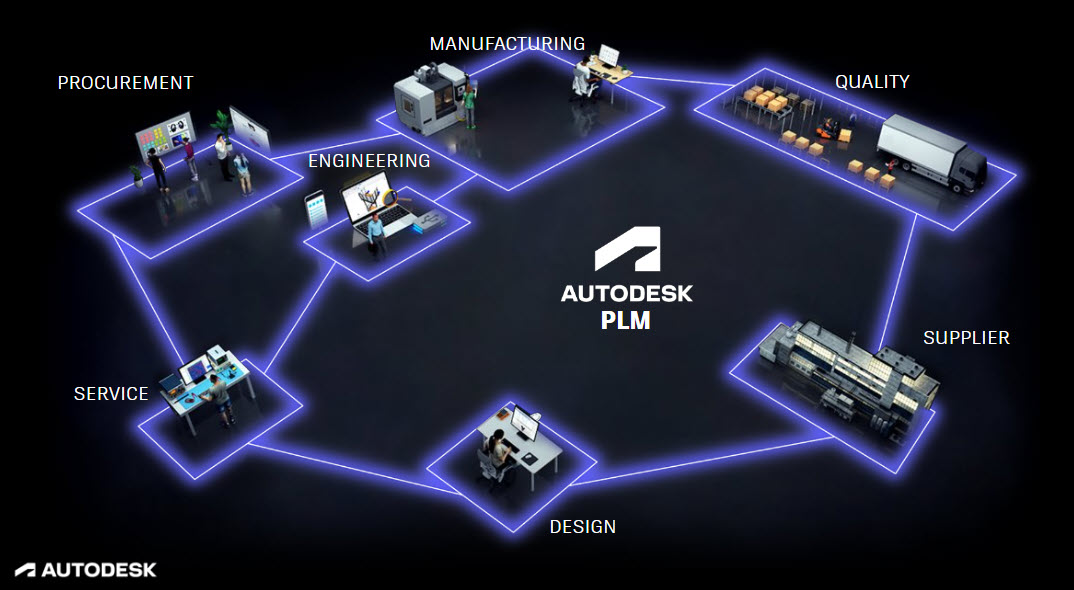
Quality management as an integral part of design, engineering and manufacturing with cloud services (Cloud PLM) – what savings can it deliver?
In Norway, many small and medium-sized industrial companies face challenges such as fragmented data systems, manual processes, a lack of traceability, and delays in detecting errors. Rather than having design, manufacturing and quality departments operate separately, an integrated cloud-based PLM system (Product Lifecycle Management) can make quality management an integral part of the company's processes. This can deliver significant operational benefits and cost savings for a Norwegian SME.

Below, we look at how this approach works and the specific benefits that can be expected, including examples and caveats.
Examples of how quality management works in traditional workflows:
- Design is carried out in isolation and handed over to manufacturing without quality control being involved in the design phase.
- The BOM (Bill of Materials) and drawings often arrive separately as fragmented information.
- Errors or non-conformances are only discovered during manufacturing or even at delivery.
- Changes and improvements have to be sent back manually to design / engineering, often resulting in lost information, delays and misunderstandings.
- Solutions and corrections are handled on an ad hoc basis, without systematic feedback to earlier phases.
Using a cloud-based PLM system such as Autodesk Fusion Manage makes it possible to:
- Integrate design, manufacturing and quality data in a single platform.
- Automate workflows: non-conformances (NCR — Non-Conformance Report), corrective / preventive actions (CAPA), inspections and engineering change requests (ECR) can be closely linked to manufacturing and quality processes.
- Ensure traceability: every action, change and documentation step is logged, making the full history available in the event of a non-conformance.
- Feed lessons learned from errors, non-conformances and customer complaints back into design, engineering and supplier management to avoid repeating mistakes in future products or projects.
The result is that quality management becomes embedded throughout the product lifecycle, rather than something carried out "on the side" in isolated IT solutions.
Savings and efficiency gains for a Norwegian SME
Here are typical areas where a Norwegian industrial company can save money or improve margins by implementing such a system:
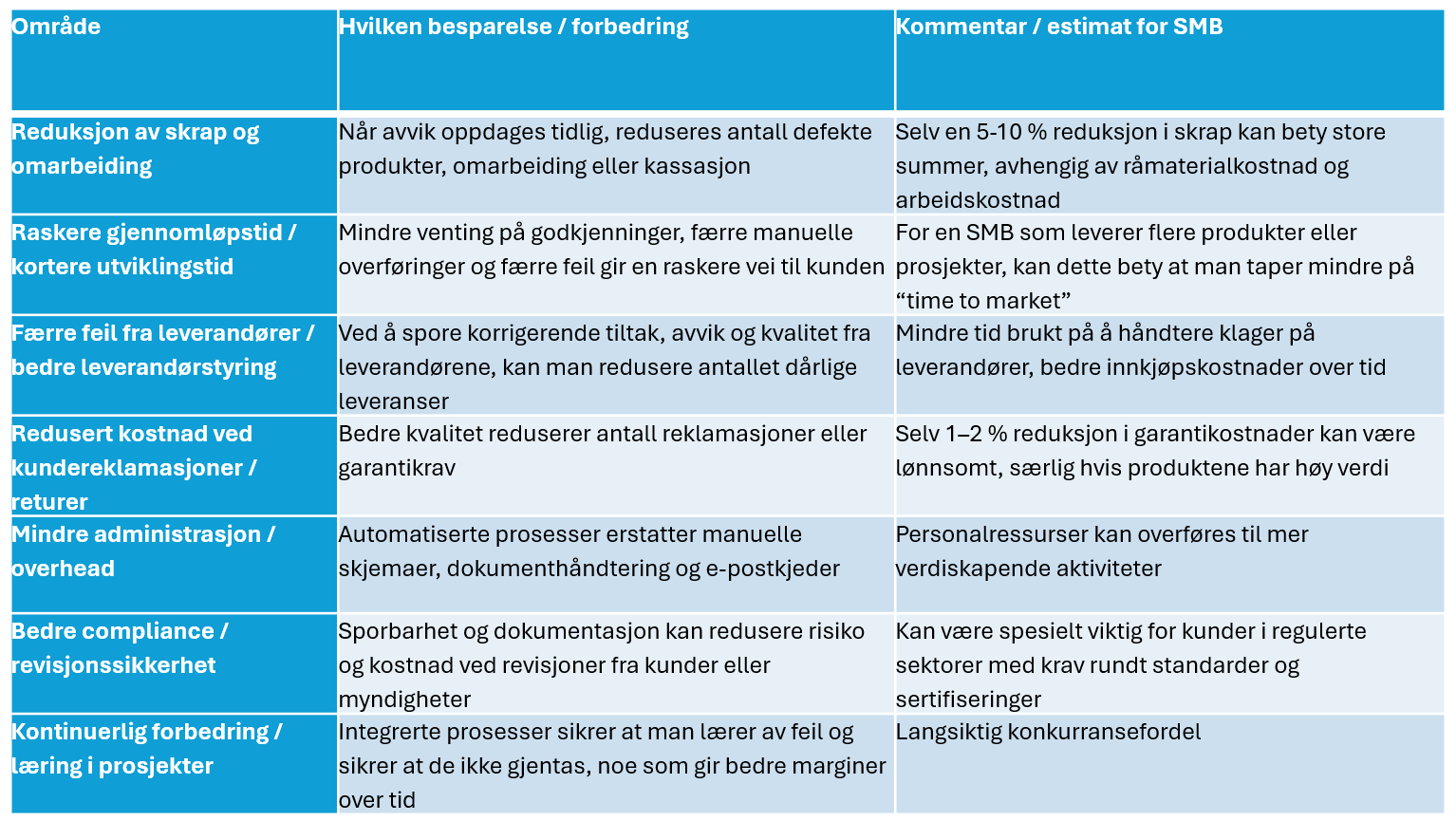
Overall, this type of system can deliver returns through reduced costs, increased productivity and better quality, all of which are critical to an SME's margins.
Potential challenges and prerequisites for a good ROI
To achieve these savings, it is important to be aware of certain prerequisites and risk factors:
- Implementation costs and change management
Implementing PLM, integrating it with existing systems (ERP, production management, CAD, etc.), and getting employees to change how they work requires time and resources. - Suitability for SMEs
Small and medium-sized companies must ensure that the solution does not become too complex or expensive relative to its benefits. The solution should be modular and scalable. - Data quality and maintenance
A PLM system is only as good as the data entered into it. If errors and inaccuracies persist, the system will not help. - User adoption
Employees must use the system correctly and consistently (recording non-conformances, following workflows, documenting changes). - Integration with other systems
To realise the full benefits, PLM must be connected not only to CAD, but also to ERP and a manufacturing execution system (MES). Without integration, bottlenecks can arise. - Ongoing maintenance and support
Software costs, support and updates must be included in the total cost of ownership.
Example: An illustrative calculation for a small industrial company in Norway
Let us assume the following for a fictional Norwegian SME in mechanical manufacturing:
- Revenue: NOK 50 million
- Material and component costs: NOK 20 million
- Labour costs for manufacturing and rework: NOK 10 million
- Warranty costs / customer complaints / returns: NOK 1 million
- Administration / overheads: NOK 5 million
Suppose that cloud PLM successfully reduces:
- Scrap & rework by 5% → savings = 0.05 × 10 million = NOK 0.5 million
- Warranty costs by 20% → savings = 0.2 × 1 million = NOK 0.2 million
- Administrative overheads (working time spent coordinating error resolution and on manual processes) by 10% → savings = 0.1 × 5 million = NOK 0.5 million
Total savings: 0.5 + 0.2 + 0.5 =NOK 1.2 million per year.
If the investment in PLM (licensing, implementation, integration, training) over 3 years amounts to, for example, NOK 0.8 million, the project could pay for itself within the first year or two, and deliver net value thereafter.
Of course, the figures will vary depending on company size, industry, product type, and so on.
In summary, why is this relevant to Norwegian SMEs?
- Making quality management an integral part of design, engineering and manufacturing with the help of PLM means that errors are detected and corrected earlier, at a lower cost.
- For small and medium-sized industrial companies, even moderate improvements (a few per cent) can deliver substantial monetary savings.
- Proper implementation, good data management, integration and adoption are key to PLM projects.
- Over time, companies can build a competitive advantage through consistent quality, lower costs and a faster response to the market.